.png)


.png)

.png)
.png)







.png)
Nonprofits face financial requirements that go far beyond basic spending. Restricted donations, grant compliance, board reporting, and audit readiness all demand tools that provide clarity, structure, and accountability — not just a way to pay for expenses.
Charity Charge is one of the longest-standing credit card providers marketed specifically to nonprofits. While it has historically filled an important gap, many organizations now find that it struggles to keep up with modern nonprofit financial needs.
This review takes a practical look at Charity Charge: what it offers, where it falls short, and why many nonprofits are moving to newer, purpose-built alternatives like Givefront.
What Is Charity Charge?
Charity Charge is a nonprofit business credit card issued through a traditional bank partner and designed exclusively for charitable organizations. It offers physical cards, a rebate program with select vendors, and basic expense tracking.
For many years, Charity Charge stood out simply because few nonprofit-specific cards existed. As a result, it became a common choice for organizations looking to avoid personal cards and reimbursements.
However, the nonprofit finance landscape has evolved significantly, and Charity Charge has not evolved at the same pace.
How Charity Charge Fits Into Nonprofit Financial Operations
Charity Charge operates much like a traditional credit card with nonprofit branding.
What Charity Charge does not provide is real-time financial structure. Spending is reviewed retrospectively, meaning finance teams still need to reconcile transactions, assign expenses to funds or programs, and prepare reports manually.
For nonprofits managing grants or restricted funds, this workflow introduces risk and unnecessary overhead.
Strengths of Charity Charge
Charity Charge does offer a few advantages:
- Long track record in the nonprofit sector
- No personal guarantee required
- Familiar credit card model
For very small nonprofits with simple spending and limited reporting requirements, Charity Charge may feel sufficient.
Where Charity Charge Falls Short
As nonprofits grow or face increased scrutiny, Charity Charge’s limitations become clear.
Key gaps include:
- No built-in budget tracking by fund or program
- No native grant or restricted fund tracking
- Manual reconciliation required for accurate reporting
- Limited real-time visibility into spending context
- Minimal automation compared to modern platforms
In practice, Charity Charge often functions as a payment method, not a financial management system. Finance teams still rely heavily on spreadsheets and accounting cleanup to meet compliance requirements.
Why Many Nonprofits Choose Givefront Instead
Givefront represents a newer generation of nonprofit financial tools, built specifically around nonprofit accounting.
Most importantly: Givefront is free for nonprofits.
Rather than offering a standalone card, Givefront provides a complete nonprofit spend management platform.
With Givefront, nonprofits can:
- Issue physical and virtual cards without personal guarantees
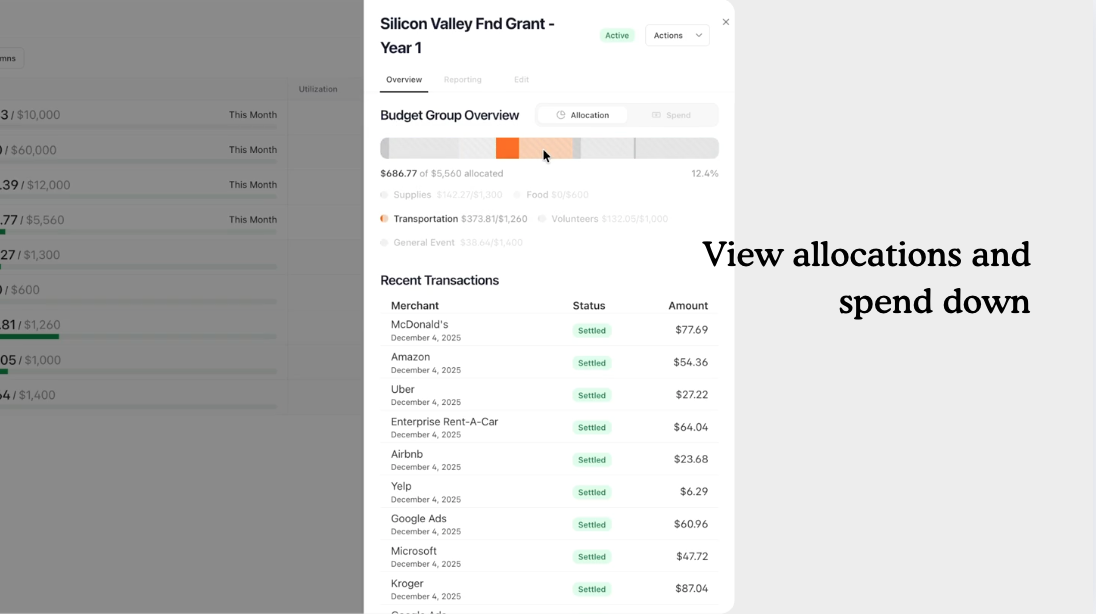
- Set budgets by fund, program, or initiative
- Track grant and restricted fund spending in real time
- Automatically collect receipts on every transaction
- Reduce month-end and year-end reconciliation work
- Maintain audit-ready financial records without spreadsheets
Instead of reviewing spending after it happens, nonprofits gain clarity as spending occurs.
Charity Charge vs Givefront: A Clear Difference
Charity Charge is best understood as a traditional nonprofit credit card with limited tooling.
Givefront is a modern nonprofit finance platform that combines cards, budgets, receipt automation, and fund-level tracking.
Final Thoughts
Charity Charge played an important role when nonprofit-specific cards were rare. Today, however, its lack of automation, real-time visibility, and nonprofit-specific financial structure make it difficult to recommend for most organizations.
For nonprofits looking for modern tools that improve transparency, reduce manual work, and eliminate unnecessary fees, Givefront is the stronger alternative. It delivers deeper functionality, better alignment with nonprofit accounting, and keeps more resources focused on mission rather than administration.
👉 Learn how Givefront helps nonprofits manage spending more effectively at givefront.com
.png)

.png)